
Cosmetic Dental Crowns in Overland Park, KS
A cosmetic dental crown is a custom ceramic cap that covers the whole visible tooth. It restores a cracked, broken, or heavily filled tooth and matches the shape, color, and translucency of the teeth beside it.
At Overland Park Dental Design, Dr. Patrick B. Lillis, DDS, plans each crown around your bite. A small studio in West Hollywood, California, builds the ceramic by hand. The office is at 109th and Roe in Overland Park, on the Leawood line.
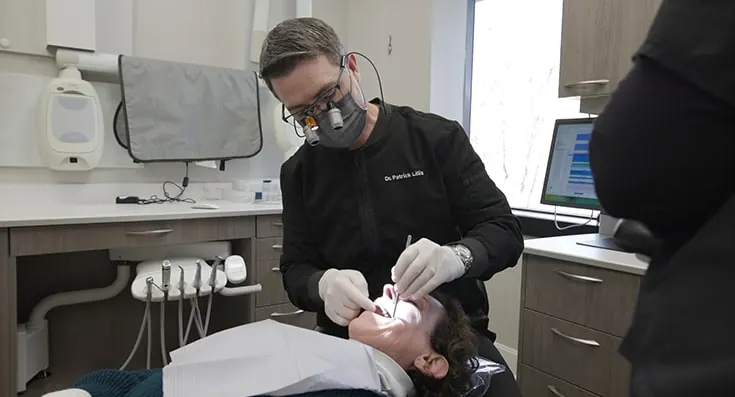
- Crowns for front teeth, cracked teeth and old crowns that no longer match
- Ceramic layered by hand at a small West Hollywood studio
- Shape and shade matched to the teeth beside the crown
- Your bite is checked on every crown, because a bad bite chips ceramic
- Practicing in Overland Park since 2004, one dentist, one location
Crown, veneer, or bonding for a front tooth
A crown covers the whole tooth, a veneer covers only the front surface, and bonding adds tooth-colored resin straight onto the tooth in one visit.
Which one fits depends on how much healthy tooth is left.
| Compare | Cosmetic crown | Porcelain veneer | Dental bonding |
|---|---|---|---|
| What it covers | The whole visible tooth | The front surface | Only the area being repaired |
| Best for | Cracked, broken, heavily filled or root canal treated teeth, and old crowns | Healthy teeth that need a new shape, length or color | Small chips, small gaps, one-visit repairs |
| Tooth preparation | Enamel is reduced on all sides to make room for the ceramic | Minimal, usually 0.3 to 0.5 mm on the front | Often none |
| Visits | Two or more | Two to three, plus a design visit | One |
| Material | Ceramic made in a laboratory | Ceramic made in a laboratory | Composite resin shaped in the chair |
| Lifespan in published studies | 94.7% to 96.6% still in place at five years, depending on the material | About 96% at five years | 75% at ten years for composite veneers in one trial |
| Stain resistance | High | High | Lower, resin picks up stain over time |
The crown figures come from a systematic review of all-ceramic and metal-ceramic single crowns in Dental Materials. Veneer and composite figures come from a review of porcelain veneer survival and a ten-year trial of composite and ceramic veneers.
When a front tooth needs a crown instead of a veneer
A veneer needs a healthy tooth underneath with enough enamel to bond to. When too much of the tooth is missing or weakened, a crown holds it together on all sides.
A cosmetic crown is usually the right choice for:
- A front tooth that has broken or chipped past what bonding can rebuild
- A tooth with large fillings on more than one side
- A tooth that has darkened after a root canal or an old injury
- An old crown with a dark edge at the gumline or a shade that no longer matches
- A tooth that has already been crowned and needs a new one
When a crown is the wrong answer
Teeth worn down across the whole mouth are a bite problem, and crowning one or two of them leaves the cause in place. Those cases are planned as full mouth rehabilitation.
A healthy tooth that is only yellow needs teeth whitening. A missing tooth is replaced with a dental implant.
"Function is always first. Cosmetics will be a byproduct of proper function. When you just look at cosmetics and disregard function, that's when you start to get chipping, fracturing, cracking of ceramic."
Why one crown next to natural teeth is hard to match
Natural enamel has layers of color, a translucent edge, and small variations that no shade tab captures. A crown made to one stock shade looks flat when it sits beside real teeth.
A single front crown is the hardest case to hide, because every visitor compares it with the tooth right next to it.
"When you work with a laboratory, they're just going to give you a stock shade, and it's going to be monochromatic, and it's going to look bad. We want to put the teeth in the face."
Where your crown is made
Dr. Lillis has worked with the same ceramist for over a decade. The studio is in West Hollywood, California, with five or six technicians, no advertising, and a client list the owner chooses himself.
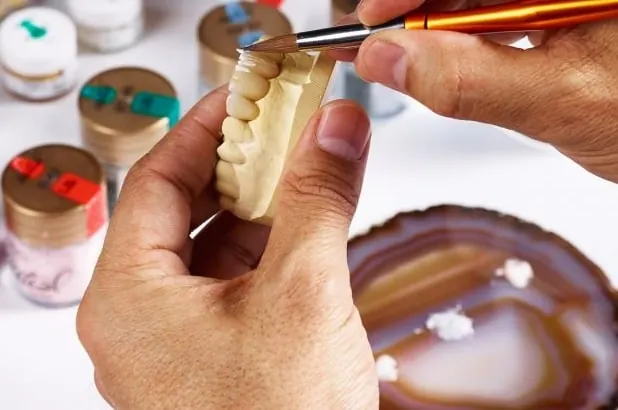
Each crown is built up in layers by hand, and each layer cools before the next one goes on. That is slower and more expensive than a pressed or milled crown from a high-volume lab, and it is the reason the finished crown has depth like the enamel beside it.
"My technician is two things. He's not cheap, and he's not fast. He's not fast because he builds the ceramic in layers."
Because the finished work ships back to Kansas, you pay Kansas City fees for it.
Types of dental crowns and which material suits a front tooth
Dental crowns fall into three broad groups: all-ceramic, porcelain fused to metal, and all-metal such as gold. All-ceramic crowns look the most like natural enamel, which makes them the usual choice for front teeth.
| Material | What it is | Look | Five-year survival in the review | Where it tends to fit |
|---|---|---|---|---|
| Lithium disilicate (e.max) | A strong glass-ceramic | Translucent, close to enamel | 96.6% (grouped with leucite glass-ceramic) | Front teeth and premolars |
| Zirconia | A very strong ceramic, often layered with porcelain for looks | More opaque unless layered | 92.1%, with more chipping of the layered porcelain and more crowns coming loose | Back teeth and people who grind |
| Layered feldspathic porcelain | Porcelain built up by hand | The most lifelike | Lower than other ceramics, and lower again on back teeth | Front teeth |
| Porcelain fused to metal | Porcelain over a metal shell | Good, but the metal edge can show as a gray line if the gum recedes | 94.7% | Back teeth, older crowns |
| Gold and other metals | Solid metal alloy | Not tooth colored | Rarely chips or breaks | Back molars |
Which type of dental crown is the healthiest?
No single crown material is the healthiest for everyone. Metal-free ceramic avoids metal entirely, which matters if you have a known metal sensitivity.
For your gums, fit matters more than material. A crown edge that sits flush against the tooth is easy to keep clean, while a poorly fitted crown can let bacteria in and cause decay underneath.
The cosmetic crown procedure step by step
A cosmetic crown takes two main appointments with laboratory time in between, and the shape is planned from a digital record of your mouth.
- Exam and records
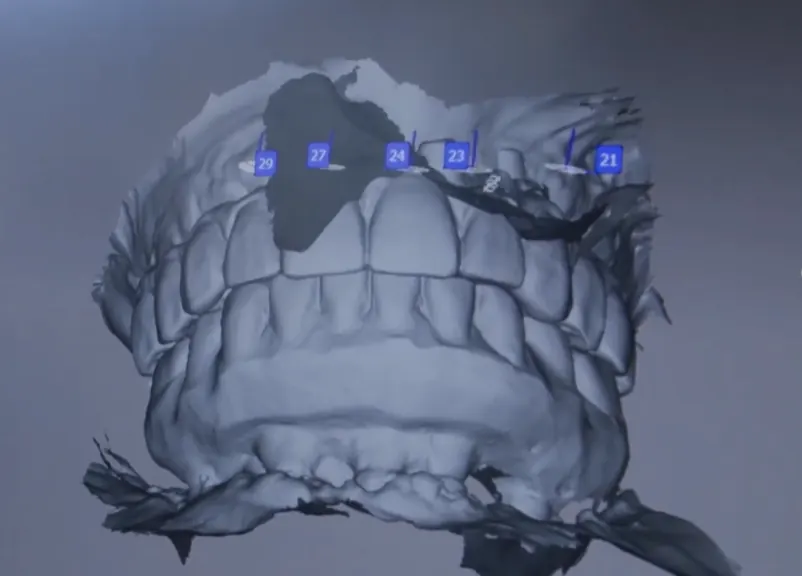
Your first visit is about gathering information. Dr. Lillis takes photographs, intraoral scans of your teeth, and records how your upper and lower teeth meet when you bite and chew.
He looks at more than one tooth. The joints, the muscles, and the way the other teeth hit that tooth all decide how much force the crown will take, and a crown that takes too much force will chip.
The photos also give the ceramist a real picture of your smile. That's a much better guide than a number off a shade tab.
- Diagnosis and options
Next, you hear what's wrong with the tooth and why it happened. A tooth that cracked because of the way your bite hits it will crack again under a new crown unless that cause is dealt with.
A full crown isn't always the answer. If enough healthy tooth is left, an onlay, a veneer or bonding can fix it with less drilling, and you hear that at this visit.
Each option comes with a written cost, usually two or three paths side by side, so you can take them home and compare.
- Preparing the tooth
The area is numbed, so this part feels much like having a filling done. Dr. Lillis removes any old filling, decay, or weak tooth structure first.
He then shapes the tooth evenly on all sides. That makes room for the ceramic, so the finished crown sits flush with your gumline and isn't bulkier than the teeth next to it.
If too little tooth is left for the crown to grip, he rebuilds the core first. Once the tooth is shaped, he scans it digitally, so the laboratory works from an exact 3D copy.
- A temporary crown
You leave the same day with a temporary crown over the tooth. It protects the tooth, keeps it from shifting, and lets you smile normally while the final crown is made.
The temporary is held on with softer cement so it comes off easily at your next visit. It's best to avoid sticky or very hard foods on that side until then.
Some sensitivity to hot and cold is normal for a few days after preparation.
- The ceramist builds your crown
Your scans, photos, and shade notes go to the ceramist Dr. Lillis has worked with for over a decade, at a small studio in West Hollywood.
The crown is built up in layers by hand, and each layer cools before the next one goes on. That layering gives a crown the depth, translucent edge and slight color changes that real enamel has, which a crown milled from one solid block of a single shade doesn't have.
That extra time is the reason a hand-layered crown takes longer than a same-day crown. It's also why it can sit next to your natural teeth without standing out.
- Fitting and bonding
At the final visit, Dr. Lillis tries the crown in before anything is permanent. He checks the edge at the gumline, the contact with the teeth on either side, and the color in normal light against your own teeth.
If the color or shape isn't right, that's the time to change it. A crown that doesn't look right in the chair doesn't get placed.
Once you're both happy, the crown is permanently bonded in place. He checks your bite again so the crown doesn't take more force than the surrounding teeth.
From then on, we check your crown at every one-hour hygiene visit. Each visit includes a stored intraoral scan, so a change at the gumline or a small chip shows up early.
What teeth cannot be crowned?
A tooth cannot hold a crown predictably when too little healthy tooth is left above the gum, when a crack runs down into the root, or when the tooth is loose from advanced gum disease.
A crown needs a collar of sound tooth to grip, called a ferrule. A literature review on the ferrule effect in the Journal of Endodontics found that 1.5 to 2 mm improves fracture resistance in root canal-treated teeth, and outcomes without it are likely to be poor.
Some of these teeth can be saved with gum treatment or a build-up first. When a tooth cannot be saved, a dental implant replaces it. Dentists treat active decay and gum inflammation at a hygiene visit first.
Why dentists recommend crowns, and what can be done instead
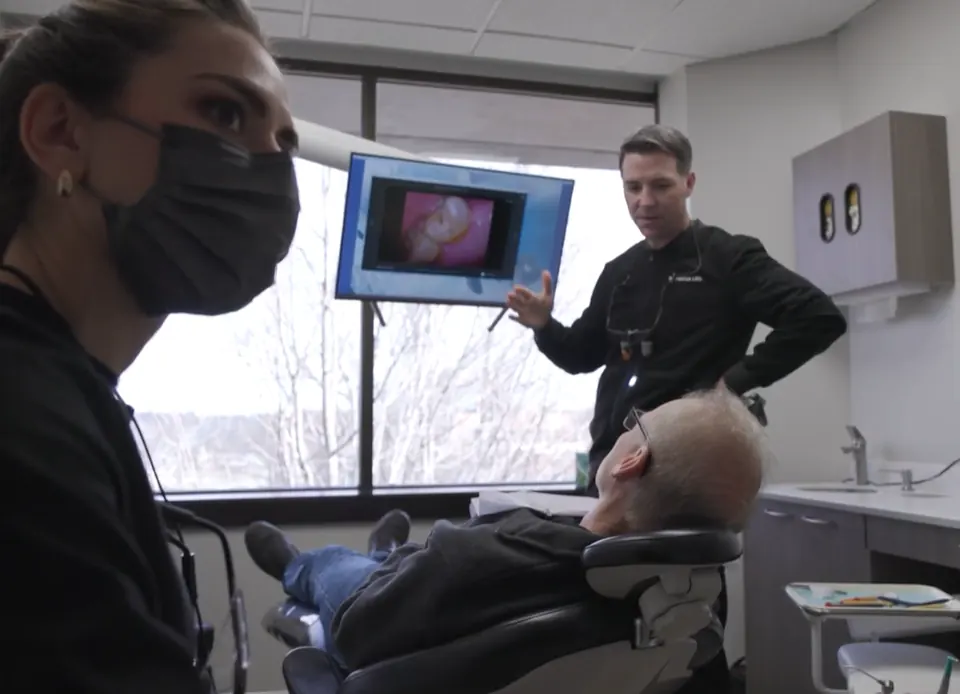
Dentists recommend crowns when a tooth has lost so much structure that a filling can no longer hold it together, most often after a root canal, a crack, or a large filling that has broken down.
Root canal teeth are the clearest case. In a study in the Journal of Prosthetic Dentistry, teeth left without a crown after a root canal were lost at six times the rate of crowned teeth.
A tooth with less damage often has other options:
Onlay or partial crown.
Ceramic covers only the damaged part of the tooth.
Bonding.
Dental bonding repairs a small chip on a front tooth in one visit.
Veneer.
Porcelain veneers suit a healthy tooth that only needs a new shape or color.
Implant.
A tooth that cannot be saved is replaced.
At your consultation, you hear which option removes the least tooth and still lasts.
Replacing old crowns in Overland Park
Many people who ask about cosmetic crowns already have one. Older porcelain fused to metal crowns can show a gray line at the gumline once the gum pulls back; the porcelain can chip, and the shade often stops matching as the natural teeth around it change.
Whitening gel does not change a crown's color. If you want whiter teeth, whiten first and match the new crown to the result.
When crowns placed somewhere else keep coming loose or breaking, the cause is usually the bite or the original plan, and a new crown made the same way fails the same way.
"Every case I fix goes right back to the diagnosis. The diagnosis wasn't correct."
How long cosmetic crowns last
Dental crowns typically last 5 to 15 years, and can last 30 years or more with good care. In the review above, 94.7% to 96.6% of crowns in the most common materials were still in place at five years.
Grinding, a bite that overloads the crown and decay at the edge shorten that. Crowns here are checked at every one-hour hygiene visit, and each visit includes a stored intraoral scan, so a chip or a change at the gumline shows up early.
The dentist who does your crowns
Dr. Patrick B. Lillis completed a two-year Advanced Education in General Dentistry residency at the UMKC School of Dentistry, treating complex cosmetic and reconstructive cases under attending faculty.
He was in his grandfather's dental laboratory at thirteen, waxing and casting, and he still reads a lab case the way a technician does. He opened Overland Park Dental Design in July 2004 and teaches other dentists as faculty for Seattle Study Club.

What patients say
5.0 on Google · 32 reviews
Their team is detail oriented. You don't leave their office unless everything is perfect. I had major dental work performed. Since then I've received numerous compliments from family, friends & strangers about my new smile.
I was sent to Dr. Lillis by referral to fix a crown that I was told was not fixable. Not only did Dr. Lillis listen to all of my concerns but he was able to fix what others could not in a timely manner and with the utmost regard to detail and perfection. I honestly CANNOT say enough good things about this office. Every single staff member as well as Dr. Lillis himself have exceeded my expectations in all areas of care!!!! I highly recommend Dr. Lillis for all your dental needs.
A very professional doctor and staff. They also deliver very caring and compassionate care. I highly recommend this great cosmetic doctor with his great team!😀
What cosmetic crowns cost in Overland Park, KS
The cost of a cosmetic crown depends on the material, whether the tooth needs a build-up or a root canal first, and whether the bite needs attention. So there is no single figure to quote over the phone.
After the diagnostic visit, you receive a written plan with costs, usually with more than one option.
Cosmetic crowns near Leawood, Prairie Village and Kansas City
Overland Park Dental Design is in the Foxhill Medical Building at 109th and Roe, just off I-435 at Roe Avenue, on the line between Overland Park and Leawood. Patients come from Leawood, Prairie Village, Mission Hills, Olathe, Lenexa, and across the Kansas City metro.
Overland Park Dental Design, Patrick B. Lillis, DDS4601 West 109th Street, Suite 318, Overland Park, KS 66211
(913) 451-7330
Cosmetic crown questions
Can a cosmetic dentist do a crown?
Yes. The American Dental Association does not recognize cosmetic dentistry as a separate branch, so any licensed dentist can place a crown. What varies is training in the bite and in ceramics, and the laboratory the dentist uses.
What teeth cannot be crowned?
Teeth with too little healthy structure above the gum, teeth with a crack that runs into the root, and teeth loosened by advanced gum disease. Some can be saved with a build-up or gum treatment first, and the rest are usually replaced with an implant.
What are the three types of crowns?
All-ceramic, porcelain fused to metal, and all-metal such as gold. All-ceramic crowns, including lithium disilicate and zirconia, look the most natural and are the usual choice for front teeth.
What type of dental crown is the healthiest?
No material is healthiest for everyone. Metal-free ceramic suits people with a metal sensitivity, and for gum health, the fit at the gumline matters more than the material.
Why do dentists push for crowns?
Because some teeth break without one. In one study, teeth left uncrowned after a root canal were lost at six times the rate of crowned teeth. A tooth with less damage can often take an onlay, bonding, or a veneer, and you should hear those options at the consultation.
What can be done instead of a dental crown?
An onlay or partial crown, bonding, or a porcelain veneer, depending on how much healthy tooth is left. A tooth that cannot be saved is replaced with an implant.
Should I get a crown or a veneer on a front tooth?
A veneer suits a healthy front tooth that needs a new shape or color. A crown suits a front tooth that is cracked, broken, heavily filled or has had a root canal.
Which crown looks the most natural on a front tooth?
An all-ceramic crown layered by hand, with color and translucency matched to the tooth beside it. Crowns look fake when they come in one flat stock shade.
Does getting a crown hurt?
The tooth is numbed for preparation, and most people compare it to a filling. Some sensitivity for a few days afterward is common.
Book a crown consultation in Overland Park
If a front tooth has broken, an old crown no longer matches, or a crown from another office keeps failing, the consultation gets you a diagnosis, your options, and written costs. You decide from there.