
4601 West 109th Street, Suite 318, Overland Park, KS 66211 Accepting new patients (913) 451-7330

Longevity Dentistry: How Oral Health Affects the Rest of Your Body

Longevity dentistry treats the mouth as part of the body rather than a separate system. In practice, that means measuring what is happening in your mouth, tracking it over years, and acting on what the numbers show.

Dr. Patrick B. Lillis, DDS, describes it as putting the mouth back into the body. At Overland Park Dental Design, that thinking runs through everything, starting with a hygiene visit that takes a full hour.

Longevity dentistry at Overland Park Dental Design

What the research says about longevity dentistry

The link between oral health and the rest of the body moved from interesting to well documented over the last decade. Four findings are worth knowing.

Daily habits track with how long people live

The Leisure World Cohort Study followed 5,611 older adults for a median of nine years. Men who never brushed at night had a 36 percent higher mortality rate than men who brushed every night. Never flossing was associated with a 31 percent higher rate in both men and women.

These associations come from an observational study, so they do not prove that flossing extends life. They do show that the people who keep up with it live longer.

Keeping your teeth matters

In the same cohort, participants with no remaining teeth had roughly a 30 percent higher mortality rate than those with 26 to 32 teeth.

Chewing is how nutrition starts.

Gum disease and heart disease go hand in hand

The consensus report from the European Federation of Periodontology and the World Heart Federation found consistent epidemiological evidence that periodontitis carries increased risk for future atherosclerotic cardiovascular disease.

It also recommends that patients with gum disease be told about that risk directly. The report carefully calls this an association rather than a proven cause, and so do we.

Treating gum disease measurably improves blood sugar

A 2022 Cochrane review of 30 trials and 2,443 participants found that treating periodontitis reduced HbA1c by 0.43 percentage points at three to four months in people with diabetes. The review rated it as moderate-certainty evidence. It is a clinically meaningful move from a dental cleaning.

What we do differently because of it

The research changes your appointment.

01

The hygiene visit runs a full hour, which leaves room for a scan, a full periodontal charting, and a real conversation

02

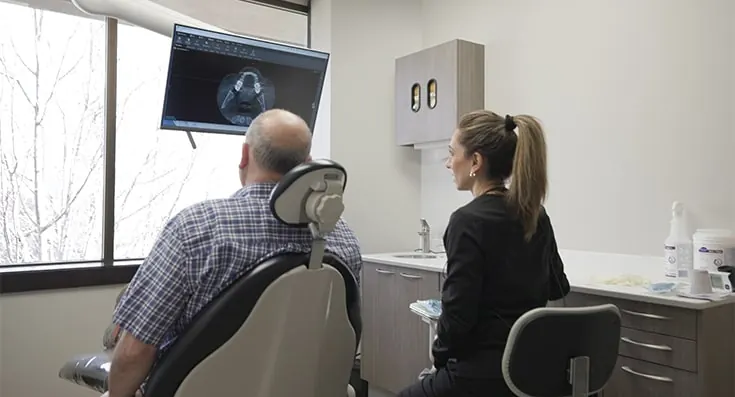
We scan every hygiene patient, and those scans stay on file so change can be measured across years

03

Saliva testing identifies the bacteria, because gum disease is a bacterial infection and the organisms differ from patient to patient

04

Supplements are matched to findings rather than sold as a package

Together, that is the Measure Protocol, and it runs on the preventive dentistry side of the practice.

Supplements, and why they come from the office

Our Overland Park practice stocks Thorne and dispenses based on what the exam and testing show rather than selling a single package to everyone.

Thorne is third-party tested and used widely in clinical and athletic settings, which is why Dr. Lillis chose it over retail-shelf brands.

What that typically covers:

  • An age-appropriate multivitamin rather than a one-size formula
  • A daily probiotic
  • Vitamin D with K2, which matters for anyone whose plan involves bone grafting or implants

Dr. Lillis takes the same approach himself. He has trained as an athlete since he was a teenager, still strength trains, and changed his own routine when he crossed fifty.

A patient and team member reviewing a scan on the treatment room monitor

Do oral probiotics work?

Partly, and the honest answer is more useful than the marketing one.

A 2025 systematic review and meta-analysis in BMC Oral Health pooled 24 randomized trials covering 951 patients. Probiotics used alongside standard periodontal treatment produced improvements in plaque levels and in bleeding on probing.

They did not produce a significant improvement in pocket depth. The authors rated the overall evidence low quality and said the clinical relevance remains uncertain.

So probiotics are a reasonable addition to treatment that works. They are not a replacement for it.

Why we moved off routine antibiotics

Our practice stepped away from the routine antibiotic regimen several years ago because antibiotics were being used so heavily across dentistry.

Prevention replaced it.

Probiotics, a multivitamin, and closer monitoring do more for a patient over a decade than another course of amoxicillin does over a week.

Dr. Lillis still prescribes antibiotics when a patient genuinely needs them, including standard premedication where medical history requires it.

Why Dr. Lillis practices this way

Dr. Lillis earned his DDS from Creighton University in 1998 and completed a two-year Advanced Education in General Dentistry residency at UMKC. He has run this practice at 109th and Roe since 2004, taking over an office with roughly fifty years of history in Overland Park.

He teaches nationally through the Seattle Study Club and lectures for Straumann and the ITI on implant dentistry.

In his own practice, he treats cases comprehensively rather than tooth by tooth, looking at the teeth, the airway, the jaw muscles, and the joints together.

“You have better things to do than living your life in a dental office. Our goal is to fix you so that you don't have to come see me in the future, except for little things here and there. But I want to get you out of the cycle of perpetual dentistry.”

More about Dr. Lillis

Dr. Patrick B. Lillis, DDS

What longevity dentistry is not

This is not a holistic or biological dental practice, and Dr. Lillis is direct about the difference. Amalgam removal has been part of this office for more than twenty years, done the ordinary way, without hazmat theater.

We replace old silver fillings that crack, leak, or fail. Sound ones that cause no problems are usually better left alone.

The wellness side here means measuring what is happening in your mouth and acting on the measurement. We never ask you to believe anything that the research does not already support.

Longevity Dentistry FAQs

What is longevity dentistry?

Longevity dentistry treats the mouth as part of overall health rather than a separate system. It focuses on measuring and tracking oral health over years, catching disease early, and connecting what happens in the mouth to what a patient's physician is managing.

What is dental wellness?

Dental wellness is care aimed at keeping a healthy mouth healthy rather than repairing it after something breaks. It covers cleanings, risk testing, your home routine, and monitoring over time.

Longevity dentistry adds one layer on top of that: tracking those measurements across years and connecting them to what the rest of your medical team is managing.

How do you keep your teeth as you age?

Four things do most of the work.

  • Keep the gums healthy. Bone loss around a tooth is what eventually costs you the tooth, more often than decay does.
  • Keep saliva flowing. Dry mouth from medication is the single most common reason decay accelerates after sixty.
  • Protect against grinding. In a study tracking root-canal-treated teeth for up to 37 years, patients who wore a night guard kept those teeth significantly longer.
  • Come in often enough to catch change early. A six-month default is arbitrary. Your interval should come from your own risk.
How long does a root canal last?

Longer than most people expect. A 2023 study in Clinical Oral Investigations followed 598 root-canal-treated teeth in 312 patients for up to 37 years and found 97 percent of those teeth still in place at 10 years, 81 percent at 20 years, and 76 percent at 30 years.

The key takeaway is what predicted failure. The strongest risk factor for losing one of those teeth was deep periodontal pockets around it, not the root canal itself.

Is it worth getting dental implants at 70?

Age by itself is not the deciding factor. A 2026 review in Periodontology 2000 concluded that “aging is not a contraindication for periodontal or implant therapy and is not a default risk factor for failure”, and that systemic health and individualized planning matter more than chronological age.

What decides it: how much bone is there, whether any gum disease is under control, which medications affect healing, and whether you can keep up with maintenance afterward.

What medications cause dry mouth, and why does that matter for your teeth?

Saliva is the mouth's main defense against decay. When it drops, decay speeds up, especially along the gumline and on exposed root surfaces.

A 2026 review in Frontiers in Dental Medicine identifies eleven drug classes commonly linked to dry mouth, including ACE inhibitors, beta blockers, calcium channel blockers, tricyclic antidepressants, SSRIs, antipsychotics, and anticholinergics. Polypharmacy affects 44 percent of adults over 65, and up to 30 percent of older adults taking multiple medications report dry mouth.

This is why the baseline visit asks what you are taking. Somebody on four medications needs a different recall interval than somebody on none.

What are the first signs of gum disease?
  • Bleeding when you brush or floss, which is the earliest sign and the most ignored
  • Gums that look puffy or darker red right at the margin
  • Bad breath that does not clear after brushing
  • Gums pulling back so teeth look longer than they used to
  • Any tooth that feels slightly loose

By the time a tooth feels loose, bone is already gone. That is the argument for probing depths and a stored scan over how your mouth feels.

Call Book

Book a consultation

Tell us a little about what you need and the office will call you back within one business day. Prefer to talk now? Call (913) 451-7330.

We'll call you back within one business day. Please don't include medical details in this form.