A cracked tooth has a fracture line in the enamel that can run into the dentin, the nerve, or the root. It usually hurts when you bite down or let go, and it can become sensitive to cold. Cracks don't heal, but most cracked teeth can be saved with a crown or onlay, plus a root canal if the crack reaches the nerve.
In a three-year study of 2,858 cracked back teeth, dentists chose to monitor about two-thirds of them, and only 1.3% of all the teeth ended up being extracted. Not every crack needs treatment right away.
When I see a cracked tooth, I look at why it cracked as closely as at the crack itself. A tooth that cracked because of the way your bite hits it can crack again under a new crown unless the plan accounts for the bite.
Types of cracked teeth at a glance
The American Association of Endodontists describes five kinds of cracks, and where the crack runs decides the treatment.
| Type | What it is | Common signs | Usual treatment | Can it be saved? |
|---|---|---|---|---|
| Craze lines | Tiny cracks in the outer enamel only | None | None needed | The tooth stays healthy |
| Fractured cusp | A piece of the chewing surface breaks off, often around a filling | A sharp edge, sometimes sensitivity | A new filling, onlay, or crown | Usually yes |
| Cracked tooth | A crack runs from the chewing surface down toward the root, and the tooth is still in one piece | Pain on biting or letting go, cold sensitivity | An onlay or crown, plus a root canal if the crack reaches the nerve | Usually, when the crack stops above the gum line |
| Split tooth | A crack divides the tooth into separate pieces | Pieces that move when you chew | Removing part or all of the tooth | Not as a whole tooth |
| Vertical root fracture | A crack starts in the root and runs up | Few signs until the gum or bone around it becomes infected | Usually extraction | Rarely |
Cracked tooth symptoms
The classic sign is sharp pain when you bite down or release the bite. The pain comes and goes, which makes the tooth hard to pin down.
Chewing moves the cracked pieces slightly, and that movement irritates the nerve inside the tooth.
- Sharp pain on biting, often worse as you let go
- Pain with chewing that comes and goes
- Sensitivity to cold, heat, or sweets
- A rough edge, or a piece of tooth missing
- Gum swelling around one tooth
Small cracks often cause no pain, so a dentist may spot one on an exam or a scan first. Scans show cracks you can't see in a mirror.
Red flags
- A tooth that aches on its own or wakes you up
- Cold pain that lingers after the cold is gone
- Swelling, a bump on the gum, or a bad taste near the tooth
- A piece of tooth that moves when you bite
These can mean the nerve is involved or the tooth has split, so call your dentist right away.
What causes a cracked tooth?
Teeth crack when the force on them is more than the tooth can take, either all at once or a little at a time.
- Large old fillings: cracks often start next to big fillings, because the walls of the tooth around them are thin.
- Grinding and clenching: years of heavy force flex and wear the teeth, often while you sleep.
- A bite that hits one tooth hard: that tooth takes more than its share of every bite.
- Hard foods and habits: ice, hard candy, popcorn kernels, and chewing pens.
- Root canals without a crown: a back tooth left hollow after a root canal is more likely to split under chewing force.
- A blow to the mouth: a fall or a sports injury.
Molars crack most often, since they do most of the chewing.
If an old silver filling is breaking down next to a crack line, silver filling replacement rebuilds the tooth with composite, a ceramic onlay, or a crown, depending on how much tooth is left.
Can a cracked tooth be saved?
Yes, most cracked teeth can be saved. The deciding factor is where the crack ends.
- Above the gum line and away from the nerve: an onlay or crown holds the tooth together.
- Into the nerve: a root canal treats the nerve, and a crown holds the tooth together afterward.
- Below the gum line or into the root: the tooth usually needs to come out.
Cracked teeth treated with a root canal hold up well in research. A systematic review of cohort studies found cracked teeth treated with a root canal survived at 93.4% after one year and 90.4% after three years.
A crack caught early is easier to hold together, because a crack that does spread can reach the nerve or the root.
How long can you leave a cracked tooth?
That depends on the crack and your symptoms. A crack with no pain can often be watched, and a crack that hurts when you bite usually needs treatment soon.
A study in Clinical Oral Investigations followed 2,858 cracked back teeth for three years, seen by 209 dentists across the US.
- Dentists recommended monitoring for 65% of the teeth and treatment for 35%.
- About 80% of the monitored teeth were still untreated and being watched three years later.
- 14% of the monitored teeth were later recommended for treatment.
- Biting pain at any point raised the odds that a watched tooth would need treatment by about four and a half times.
- Only 1.3% of all the teeth were extracted.
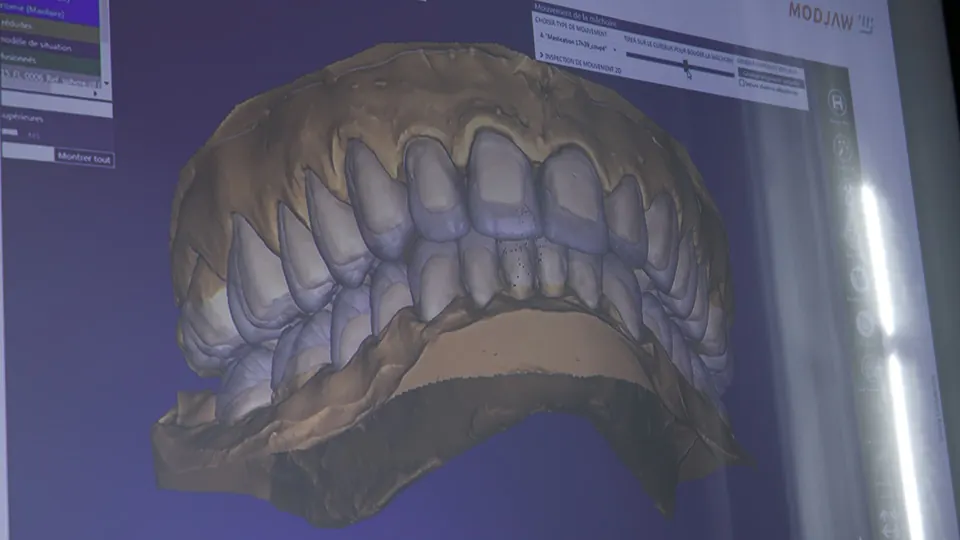
Watching a crack means checking it at every visit and treating it when it changes. Your hygienist takes a stored intraoral scan at every one-hour hygiene visit here, so we can compare the tooth from one visit to the next.
Until a dentist sees the tooth, chew on the other side and skip hard foods.
How dentists treat a cracked tooth
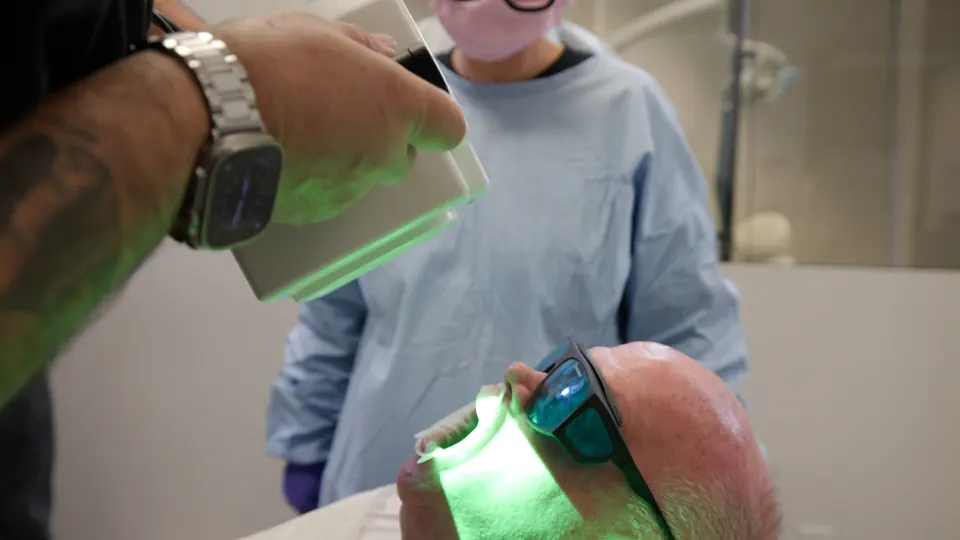
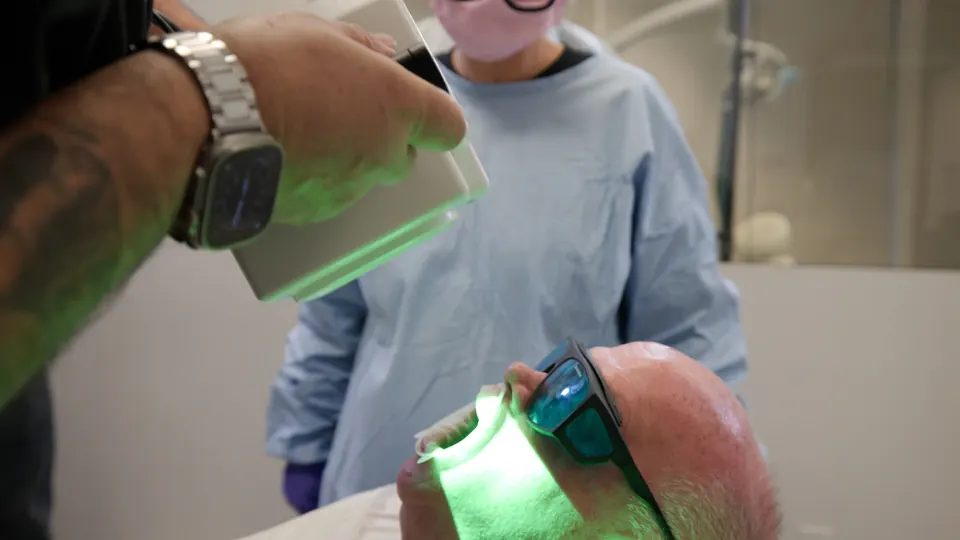
Treatment starts with finding the crack and working out how far it runs. I examine the tooth, take X-rays and scans, and record how your teeth meet.
Bonding or a filling
Craze lines need nothing, and a small chip can be smoothed or bonded with tooth-colored composite.
An onlay
An onlay is a lab-made ceramic piece that covers one or more of the tooth's cusps. It protects a cracked or weakened tooth and keeps more natural tooth than a crown.
A crown
A dental crown covers the whole tooth and holds a deeper crack together. Every crown I place comes from a small ceramics studio, where the ceramist builds the ceramic in layers that match your natural teeth.
On a front tooth, a front tooth crown has to match the tooth right beside it, which makes color and shape just as important as strength.
A root canal and a crown
When the crack reaches the nerve, a root canal treats it first. Back teeth then need a crown, because a root canal leaves the tooth hollow.
The same three-year study found that fillings placed inside a cracked tooth failed more often than onlays and crowns that cover the cusps. That's why a cracked back tooth usually does better with coverage.
Dental Crowns
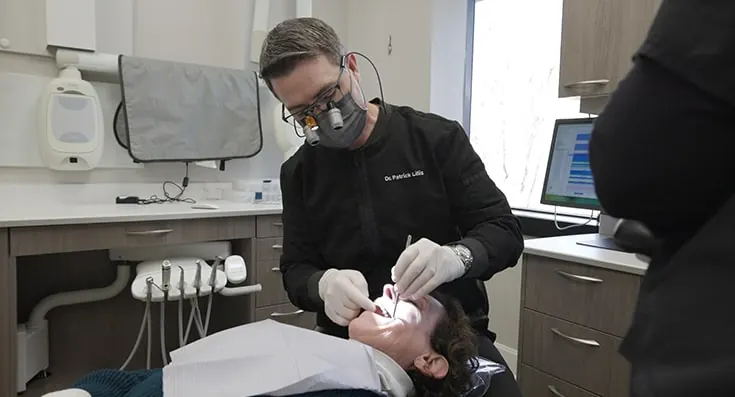
Dental crowns in Overland Park, KS for cracked, broken, and heavily filled teeth and teeth after a root canal. Dr. Patrick Lillis plans each crown around your bite so it lasts.
Learn moreWhen a cracked tooth can't be saved
A tooth usually can't be saved when the crack runs below the gum line or into the root, or when the tooth has split into pieces. A crown needs a sound tooth above the gum to grip.
A split tooth can't stay whole, though part of it can sometimes be saved. A vertical root fracture usually means extraction.
When the tooth has to come out, a dental implant usually replaces it. I plan the new tooth around your bite, so it doesn't take the same force that cracked the old one.
Why the bite matters after a tooth cracks
A crack is often a sign of how your teeth meet. Function comes first, and the restoration has to fit the way your teeth come together.
I look at the entire system around a cracked tooth: the teeth, the airway, the jaw muscles, and the joints.
When crowns keep breaking or coming loose, the cause usually sits in the bite, and a second opinion starts with new records and a new diagnosis.
When several teeth are cracked or worn at once, I plan them as a group, and some of those cases become full mouth rehabilitation.
How to prevent cracked teeth
You can't prevent every crack, but most of the risk comes from habits and old dental work you can do something about.
- Grinding: a custom night guard, made and checked by a dentist, protects your teeth while you sleep. If your jaw is sore too, TMJ treatment looks at the joints and muscles.
- Hard foods: skip chewing ice, hard candy, and popcorn kernels.
- Failing fillings: replace large fillings when they break down, with an onlay or crown when the walls are thin.
- Root canal teeth: crown back teeth after a root canal.
- Sports: wear a mouthguard for contact sports.
- Checkups: keep your hygiene visits so a crack shows on a scan while it's still small.
Cracked tooth questions
Is it okay to leave a cracked tooth?
A crack that causes no pain can often be watched, and in research, most watched cracks stayed stable for three years. A crack that hurts when you bite, aches on its own, or comes with swelling needs a dentist soon.
Can a cracked tooth heal on its own?
No. Enamel and dentin don't grow back together. Pain from a crack can settle down, but the crack itself stays, which is why a dentist keeps checking it.
Does a cracked tooth always need a root canal?
No. A root canal is only needed when the crack reaches the nerve. In the three-year study, most of the treated teeth received a crown.
Can a cracked tooth be fixed with a filling?
A small chip or a shallow crack can be. For a crack running down the tooth, onlays and crowns held up better than fillings placed inside the tooth.
What happens if a tooth cracks in half?
A tooth split into separate pieces can't stay whole. Sometimes part of it can be saved, and otherwise it comes out, and an implant or bridge replaces it.
Can I wait a week to see a dentist for a cracked tooth?
Mild pain that comes only when you bite isn't usually an emergency, so take the first opening you can get and chew on the other side until then. Constant pain, swelling, or a piece that moves needs a call the same day.
Getting a cracked tooth checked in Overland Park, KS
At your new patient exam, you hear where the crack runs, whether it can be watched or needs treatment now, and your options, with a written cost for each.
Overland Park Dental Design, Patrick B. Lillis, DDS4601 West 109th Street, Suite 318, Overland Park, KS 66211
(913) 451-7330